


When your hair is fine, conditioner can feel like a compromise: it feels soft when you rinse, but a few hours later your lengths fall flat. Yet skipping this step altogether is not necessarily the answer. What matters most is the formula you choose, how much you use and where you apply it.
Fine hair has a smaller strand diameter than thick hair; that does not necessarily mean you have fewer hairs. It may still need detangling and protection, even if your roots get oily quickly. Here's how to keep your routine comfortable without losing movement.
Fine hair and thinning hair are not the same thing
You can have plenty of very fine strands and still have a full-looking head of hair. Conversely, you can have thick strands but relatively few of them. The distinction matters: fineness refers to the diameter of each strand, while density refers to the number of hairs in a given area.
If your strands are fine, they can lose their bounce quickly when you layer rich textures or apply treatments too close to the scalp. The aim is not to eliminate every nourishing product, but to focus it where it is useful.
Look at the condition of your lengths, too. Coloured, bleached or frequently heat-styled ends may need more conditioning than untreated fine hair with little damage. There is no single rule for every head of fine hair.
Do you really need conditioner for fine hair?
In most routines, yes. After washing, conditioner helps soften the lengths and makes detangling easier. By reducing friction and knots, it can make styling gentler. That is a different job from shampoo, whose main purpose is to cleanse the scalp.
Dermatologists at the American Academy of Dermatology recommend using conditioner after washing, focusing on the ends for fine or straight hair. This distinction matters more than a promise of 'instant volume' on the bottle.
If a product seems to weigh your hair down, first try adjusting the amount, the processing time and the area of application. You can then work out whether the texture itself is too rich for you.
Which texture helps keep lengths feeling light?
You cannot judge a conditioner solely by how it feels in your hand. Some creams rinse away easily; others leave a more enveloping finish. The real test comes when your hair is dry: does it feel soft, easy to style and free to move, or does it fall into heavy-looking sections?
For fine hair with little damage, start with a detangling formula and use a small amount. If your ends are dry, a more comforting formula may be preferable, but keep it on the areas that need it. A 'fine hair' label can help you narrow down your choices, but the result on your own hair matters more.
The presence of oils, silicones or conditioning agents does not automatically make a product 'too heavy'. The effect depends on the complete formula and the amount used. Avoid definitive judgements based on one ingredient on the label.
Where should you apply it, and how much should you use?
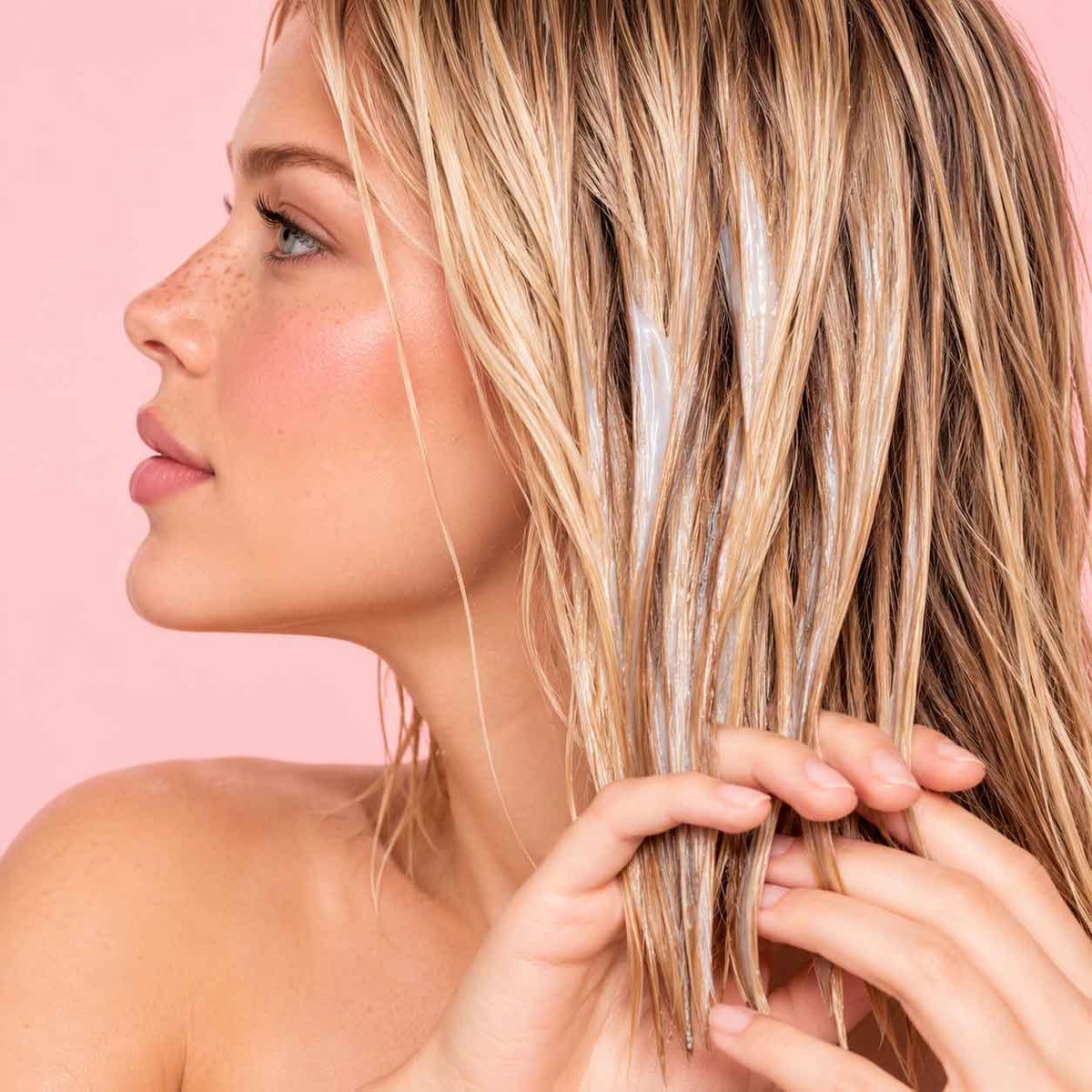
For fine hair, the simplest approach is to leave the roots alone and concentrate on the ends. After shampooing, gently squeeze out excess water. Spread a small amount of conditioner between your hands, then apply it to the last few centimetres first.
If your hair is long or tangles higher up, work gradually up the lengths without massaging the scalp as you would with shampoo. The product should coat the areas that need care, not cover every root out of habit.
There is no universal dose: it depends on your hair length, overall thickness and the formula. Start small and add more only if the ends are still difficult to detangle. Follow the brand's recommended processing time and rinse thoroughly. Rinsing too soon may not deliver the softness you expect; leaving too much product behind may make hair feel coated.
Rinse-out conditioner or leave-in treatment: which should you choose?
These two products do not serve exactly the same purpose. A conventional conditioner is applied in the shower and rinsed out. A leave-in treatment is used after washing, usually on damp lengths, to extend detangling benefits or make styling more comfortable.
With fine hair, the amount of leave-in matters particularly: start with the smallest possible quantity and distribute it only where needed. If you already use a rich rinse-out conditioner, there is no need to add several more layers straight away. First see what one well-measured step achieves.
Dermatological advice on leave-in products likewise recommends using only a little, particularly on fine hair, and avoiding the scalp. That does not mean leave-ins are off-limits: they may help damaged ends, provided a targeted touch-up does not become an all-over application.
Mistakes that can leave hair looking flat after washing
The first is applying conditioner like shampoo, from roots to ends. The second is layering a mask, conditioner and styling cream without checking whether each serves a different purpose. Even products that feel good individually can weigh hair down when combined.
Another common mistake is vigorously rubbing hair with a towel before brushing from the roots down. Wet hair is more vulnerable to rough handling. Blot it gently and begin detangling at the ends, gradually working upwards with a suitable tool.
Finally, flat hair does not always mean 'over-conditioned' hair. Oil at the roots, drying habits, wash frequency and styling products also affect the result. If you misidentify the cause, you may replace your conditioner when a different step was the real issue.
How can you build a simple routine that preserves volume?
Start with a shampoo suited to your scalp, massaging the roots rather than rubbing the lengths. Apply conditioner to the ends, rinse according to the instructions and dry without rough handling. Test a few times before changing several things at once: that is the best way to learn what actually works for you.
If you want to explore an option, take a look at Scandinavian Biolabs Hair Recovery Conditioner, available at Browlab. Whether it suits your hair depends on the formula and finish you prefer; mentioning it here is not a volume guarantee or a universal recommendation.
You can also browse Browlab’s hair care selection to compare formats and uses. The priority remains the same: find a product that makes detangling easier without adding unnecessary steps.
The key takeaway: fine hair does not mean you have to give up conditioner. Used sparingly, mainly on the ends, it can make lengths easier to style while keeping them light. If your hair still falls flat, change one thing at a time: amount, placement, rinsing, then formula. The right conditioner is not necessarily the one promising the most volume, but the one that leaves your hair soft, natural and comfortable to wear.